Search This Blog

Saturday, February 4, 2012

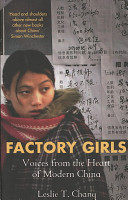
FACTORY GIRLS – Leslie T. Chang


I started this book before Christmas and just recently finished it. It is one of those nonfiction reads that you can, and must for mental health reasons, put down for a few days before picking it up again. No worries about losing your place or forgetting what you read because you will be brooding about it the whole time you are not reading.

Chang is herself of Chinese descent. She notes that being obviously of Chinese heritage helped open doors for her during her research that many before her had difficulty obtaining. She actually lived among the factory girls and scoured the cities herself interviewing the workers for her data gathering. Interspersed with the research are stories of Chang's own family exodus from China and the country's history also. Chang's own grandfather had emigrated to the USA to go to college, returned to China to help his country progress, was murdered and eventually became a hero to his descendents. All of this is woven into a very understandable and engrossing book. This book is well constructed, interesting, and well documented. I would like to find a group reading this for discussion as my book is full of sticky notes!

According to Chang since China is still a male-dominated culture, rural families still strive to have male children. They will and often do have many female children in pursuit of an heir. The males inherit all the property and assets and usually are the only children sent for further education after elementary school. In the 1990s the surplus female children began to flood the cities for work in the American factories. These girls may be anywhere from 12 to 15 when they arrive and will stay usually only until they are in their early 30s when they will feel pressured to marry and move back to the rural areas. If they can and are smart enough some will save wages to educate themselves further. Those who can educate themselves will become professionals, factory bosses, or they will emigrate.

The factory girls live in dormitories in the factory compounds. They have little, their relationships are superficial, and they are transient. Some will transfer to better jobs, some will tire and go home, and some will meet men and start homes. Many simply disappear into lives of prostitution or are killed and no one knows where they went. Chang delivers her material in a very matter of fact way so that you know the problem is complex. It is not as simple as - The Unites States puts a bunch of factories here and slaves work in them. It is true U.S. investors put factories in China and girls will make the products for very little per day. However, there are still millions of young people in China who need jobs. Families in China are still having too many children in the quest for males. Americans still want cheap goods. Americans will not make these goods as cheaply as Chinese workers will.

Chang's book lets you get to know some of these workers. She lived with them, went home to the farms with them, listened to and documented their hopes and dreams. There are other books on the market now that will give you a picture of the upwardly mobile, educated, and wealthy of China but this one is a look at the rural people who have seen, in only twenty years, the focus of their country turn from agriculture to industry and technology. The new generation of floating population is creating new classes of its own. Height is very important in this new generation that is just barely free from starvation. Each factory practices its own version of class discrimination too. If you read this book you will be entranced with the worker's stories. It isn't dark, or somber but it isn't sugar-coated either.

STORIES I ONLY TELL MY FRIENDS – Rob Lowe


Finally getting to my Christmas books. I was skeptical about this one because typically star bios are not for me. But Stories I Only Tell My Friends got such good reviews that I weakened and asked for a copy for Christmas. So glad I did too. It was actually very entertaining and fun.

Lowe came from very well-educated, intelligent, and loving parents. He became interested in acting at a very young age while growing up in Dayton, Ohio where he often acted in civic productions. He seemed, according to this memoir, a pretty well-adjusted child, a good student, a hard worker, and talented. He did suffer from his parents divorce and subsequent breakup of his mother's second marriage as well. His mother did end up moving herself and her sons to California where the Sheen's were neighbors and Rob became good friends with Emilio. Lowe relates many tales of vying for acting parts in Hollywood, navigating neighborhood life, and continuing high school. Before becoming an adult Rob was virtually living on his own in a bungalow behind the family home and basically became the major bread-winner of the family.

Chapters contain many descriptions of Lowe's first encounters with people who would later become famous. Too many to mention them all but as he rose to stardom he met and acted with many young actors including Robert Downey Jr., Michael J. Fox, Sarah Jessica Parker, Tom Cruise, and Demi Moore. His stories are well written, fun and funny. He doesn't disparage anyone either which I appreciate.

There are a few dark chapters of substance abuse and rehab but even those are not written heavy handedly. Nor does he do any “poor me” or whining about being taken advantage of or blaming anyone else for his troubles. Indeed he seems to take responsibility for his problems.

One of my favorite excerpts is on page 151 when he reflects on his relationship with his own father and what he has learned about what teenage boys really need.
“They absorb incrementally, through hours and hours of observation. The sad truth about divorce is that it's hard to teach your kids about life unless you are living life with them: eating together, doing homework, watching Little League, driving them around endlessly, being bored with nothing to do, letting them listen while you do business, while you negotiate love and the frustrations and complications and rewards of living day in and day out with your wife.”
He has remained married to the same woman for over 20 years and seems to dote on his two sons. Their family story is quite wonderful. While he did not have the stability he feels is so important, he seems dedicated to providing that for his sons. Even so he seems not at all bitter towards his parents and proudly examines the strengths each gave to him and his brothers.

It is clear that Lowe very much valued his acting experience on The West Wing TV series. He takes pride in being part of an unusually high brow project that was demanding, sophisticated, and delivered to the American public quality TV performances. I also learned from him in that chapter that sometimes one must realize that even though you know you are doing a good job, and you know you could do more or do it better if given a chance, if others don't see it, then it is time to move on. That it is OK, and not anything to be bitter about. A book that takes an afternoon to read and when you are done you give a big sigh and a “thank you” before you lay it aside.

Thursday, February 2, 2012

THE CHERRY LOG SERMONS – Fred Craddock


Zion First Tuesday Class discussed this book for the second time this past Tuesday. Sadly Pastor Mark shared that Reverend Craddock is ill and no longer is strong enough to preach. Previously Craddock was Professor Emeritus of Preaching and New Testament at Candler School of Theology, Emory University, in Atlanta, Georgia. He was also Minister Emeritus at Cherry Log Christian Church in Cherry Log, Georgia. In 2001 he was named by Newsweek one of the top 10 preachers in the country. I really enjoyed his book and am so sorry to hear this news.

Originally when Mark hinted he wanted to share this title I didn't want to hurt his feelings but I had no desire to read a whole book of sermons. Now I love my church and our pastor is a great guy and a very good preacher, but I am always ready to go home by the end of service and I couldn't imagine myself sitting for hours reading sermon after sermon. I was so wrong. This is narrative in an easy comfortable style. Each chapter begins with a New Testament reading then Craddock talking about his interpretation, thoughts, and insights. So much brilliance. My responses ran from, “hmmmm,” “really?” to “I think that way too!” He presents his material in a conversational manner, is never heavy handed or judgmental, and I never once felt like I heard echoes of Bible-thumping. So there you have it, a great read to make one ponder and do a little introspection. It's a very pretty book too. The cover is classy with an interesting picture and lovely type. If there is a significance to some of the letters in the title being white I wish someone would enlighten me. It looks like they are like that for a reason but I couldn't figure it out nor why three of them are in italics. Anyone?

The first line to capture my attention was in the first 
chapter on page 5. Craddock says, “I get sick and tired of people always thumping the Bible as though you can just open it up and turn to a passage that clears everything up.” The second one was at the bottom of that same paragraph, “I run into so many people who carry around a forty-three-pound Bible and say, “Just do what the Book says.”” When I read those thoughts I said, Me too! After all I live in the middle of the Bible-thumping belt. All my life I have been surrounded by those who profess to know exactly what a “good Christian” is and I particularly love it when they are saying such things with a raised eyebrow insinuating that you may not be one of them. Craddock makes so much sense and makes me feel at home.

My favorite sermons were numbers 8 “What God Wants This Church to Do” and 13 “Who Am I to Judge Another?” The first is based on Matthew 28:16-20. Craddock begins this sermon with a story about going with his family to a Star Wars movie which leads into thoughts about prequels, sequels, having doubts, and knowing what to do. On page 44 he says, “There have been times and places when and where people have been emotionally coerced, socially coerced, even militantly coerced into following Jesus...because somebody misunderstood what it means to make disciples.” He also said he has known some to coerce even at funerals which he calls, a “sub-Christian” thing to do.

Chapter 13 is based on Romans 14:1-12 and on page 74 Craddock gives his interpretation as thus:
“Paul said, If you want to eat just vegetables, just eat vegetables. If you want to eat meat, eat meat. But quit picking on each other. Stop forcing everybody else to fit into your pattern of eating meat, not eating meat, drinking wine, not drinking wine, keeping the Sabbath, not keeping the Sabbath. In other words, Paul said, Knock it off. Whatever you do, whether you drink or not, whether you eat or not, whether you keep the Sabbath or not. Do it to the honor and the praise of God and not in some self-righteous way to judge someone else.” Yea Craddock!

There are so many other good chapters too and if you read this book you will think about the “disease of the successful,” what is integrity, how to approach reading the Bible and many other things to make you go hmmmm. He truly preaches the love of God and how to be a humble witnessing servant. I wish I could know him personally and can only hope I meet him some day. 

THE HEART IS A LONELY HUNTER – Carson McCullers


My hands must have touched a copy of this title innumerable times throughout my career. One or more copies always resided in my library and this title was on our school AP English reading list, but for some reason I never picked it up myself. This year the Adams Central Adult Literati made this a winter reading choice. Seven members attended group and six of us liked it. The seventh didn't dislike it but it wasn't her cup of tea. I liked it very much indeed. We had a great and detailed discussion. This book was published in 1940 and illuminated many issues pervasive in our nation and our culture. As we discussed we realized so much has changed in 70 years and yet so much is still the same.

Silly as it may seem to seasoned readers and to other librarians, I was not aware McCullers was a female and I was finished with the book before I realized that the picture on the cover of my book is her! I have, since finishing the book, looked her up and found many interesting facts. For instance the character Mick and many events containing her are somewhat biographical. Describing what this novel is about is no easy task. With no defined or sequential plot I will say it is a book about people (and there are many of them to keep track of) living and maneuvering in the subcultures of the South during the late 1930s. It almost has the feel of a memoir. It is a coming-of-age story, a story of extreme loneliness, struggle, oppression, and civil disobedience.

In a small town close to Atlanta the reader gets a glimpse of the lives of 17 people whose paths cross and whose lives intersect. They often misunderstand each other and some live their existence not knowing that another is nearby who could or would be of support if they would just reach out. All of the characters have a relationship with one man, Mr. Singer, a deaf mute who lives at the Kelly boarding house. He is like the hub of a big wheel of dysfunctional and lonely people who seek him out because in his presence they feel valued and special. Each character actually attributes to Mr. Singer qualities they believe he has which fill their needs. Whether he has these or not the reader doesn't know. But as each person spends time with him, talking to him, watching his reactions, reading his notes, they work out what they think and what they must do.

Mick Kelly is trying to grow up while shouldering much responsibility. Her father has had an accident which prevents him from holding down any job where he must walk or stand and therefore he is trying to make a go of a watch repair shop in their home. Her mother runs the boarding house with the help of a local black woman. Mick is, in my opinion, the best character in the book. She has drive and spunk with great interest in literature and music. She aspires to study and leave the area to have great adventures one day.

Doctor Copeland the local black doctor supports his community with a purpose and drive that are nearly super human. But he lives a lonely existence since he alienated his family who fled long ago to the home of his in-laws. His children fear him and yet he still tries to instill some drive to better their lot in life only for his “sermons” to fall on deaf ears. Even though it is easy to feel sympathy for the family and to see why they wanted to be away from him, it is still heart breaking witnessing his loneliness for them and feeling his frustration with their lack of motivation and their use of black slang and improper English which he feels is so denigrating. Mr. Singer is the only white person the doctor has ever trusted and feels is an equal.

Jake Blount is a drifter and a drunk. He gets a job as a carnival worker while also reading books about philosophy. The reader doesn't know why he has isolated himself from family and friends but he has some of the best thoughts and lines in the book for examining the times and mores of the 1930s. My favorite is on page 158. Referring to our founding fathers these lines speak volumes;
“They fought so that this could be a country where every man would be free and equal. Huh! And that means every man was equal in the sight of Nature....This didn't mean that twenty per cent of the people were free to rob the other eighty per cent of the means to live.”
The paragraph is much longer and says a lot more but that is the essential part. How much that same sentiment remains today!

Biff the local cafe owner is a wonderful character also. His wife dies leaving him alone and pining for children. He loves his neighbors and he particularly loves Mick Kelly. He gives away food and watches out for his patrons. I think his loneliness is the most troubling because the reader knows he is passionate and good and could be a wonderful family man if he could just reach out.

The scene that haunts me the most happens quickly close to the end of the book. Several are together in Mr. Singer's room and they find they cannot communicate in each other's presence. No one ever asks Singer about his feelings or wants or plans. He is the loneliest one of all and no one seems to notice.

Those are only my favorite characters. This book is so full of things to think about and characters to ponder. Dysfunction and loneliness a plenty to examine, social issues to break your heart and beautiful writing. What else could you want?

Sunday, January 15, 2012

THE NIGHT CIRCUS – Erin Morgenstern


The Night Circus has been on my bookshelf for a month now and it was with much anticipation I finally was free enough to sit down to enjoy. I new it was going to be a wonderful artistic read, or I thought I could tell that by looking at the cover and end sheets. So lovely, it is one of the most attractive books I have purchased in a long time. Black shiny cover with white, red, and swirls of silver showing a tattooed arm holding up a tiny black and white circus with tents and a clock. The whole feel of the tangible book is magical and mysterious. I was not disappointed. This is one of those books that is tasty to examine before you start.

There was a fair amount of prepublication hype for this book which helped and hindered my reading. Being a debut novel I was prepared to dismiss a few annoying elements but some hype led me to expect things that did not develop. For instance the pr about star-crossed lovers was overdone. The lovers, Celia and Marco aren't very fleshed out with clear personalities and therefore, as a reader, I wasn't much invested in them. Plus the love story doesn't even start until over half of the novel has transpired. The introduction of Bailey, a farm boy who loves the circus, changed the whole feel of the book for me and I was by then tuning out my environs to sink into the story. Bailey, along with the twins Widget and Poppet, born in the circus to the animal trainers, and the circus itself are the real personalities that I cared about. The circus appears to be a living breathing entity with a personality and all the performers are integral to the life of the circus.

I would call this an ethereal, Gregory Maguire type fantasy novel. It even has a mysterious clock like Maguire's Wicked, characters who never age, people who aren't who they seem to be, mystery, and magic. While Celia and Marco seem flat there are a multitude of other interesting characters such as Isobel the fortune teller, Tsukiko the tattooed contortionist, Barris the architect, and Freidrick the clock maker.

“Trespassers Will Be Exsanguinated,” how could you not like a book with lines like that? This book is rich in interesting language and the well-turned sentence. Some members of book group were put off by the construction of the novel since the chapters are not chronological and the perspective shifts. I have to admit it did make it a bit difficult and I had to flip back once in a while but I even liked that aspect. If one tries reading this novel via an e-reader the flipping may be annoyingly cumbersome. There is a lot going on and many characters.

Le Cirque des Reves/The Night Circus is conceived at one of the much coveted culinary delightful “Midnight Dinners” of Chandresh LeFevre. Lefevre presents his plans to those who become the designers and collaborators; Friedrick Theissen the clock maker, Scottish sisters Tara and Lainie Burgess business consultants, Mme Padva the costume designer, and Ethan Barris the architect. Lefevre envisions a different kind of circus than one of elephants and clowns. He wants a magical show of enchantments and beauty. So begins this adventure.

Hector Bowen (Prospero the Enchanter) and Mr. A.H. (Alexander) are centuries old magicians who groom and then place two of their pupils in a “game” for which the players will need to figure out the rules and who their opponent is on their own. Both of the budding young magicians become involved with The Night Circus and the circus becomes the venue for their game. Celia becomes an illusionist in the circus and Marco becomes the personal assistant to Chandresh the owner/designer. The circus is a work of art and beauty all its own. The Night Circus travels the world, seems to appear magically, opening at dusk, closing at dawn, and the enchanted visitors while becoming enamored of the circus never suspect that they witness real magic. There are many mysterious and wonderful sights in the circus such as The Ice Garden, The Tree of Wishes, The Stargazer, living statues, the Cloud Maze, and of course the wonderful clock.

So many sub-plots to keep track of too! Celia and Marco know they are players in a game but they don't know the rules or how to determine who wins so they become collaborators in the circus and fall in love. A farm boy who wants to leave home for college or adventure but whose father expects him to take over the family farm becomes friends with Poppet and Widget, twin performers in the circus. Reveurs, like modern day groupies follow the Night Circus all over the world and dress in black with red scarves. Those associated with the circus become aware that they no longer age. Mr. Barris falls in love with the Scottish sisters. Isobel is in love with Marco but he does not love her back. Oh my and that isn't all!

Loved it, loved the adventure, even loved the non-linear plot and the many characters.

One thing I didn't love. In the beginning and at the breaks between chapters there is a constellation. I, nor any one at book group could find out what it is! Annoying.

Surprising – there is no dedication page. I like those usually and missed it.

Saturday, January 7, 2012

SARAH'S KEY – Tatiana De Rosnay


Ahh, that is my release from having just finished Sarah's Key. I have actually been meaning to read this title since we had a guest speaker two years ago at school who spoke about surviving the Holocaust. She recommended it. The Jay County Public Library Book Group has chosen to read it for January so I was spurred into picking it up again.

The book is constructed about half way in alternating chapters from 1942 to I believe 2002. The 1942 chapters contain the heart wrenching narrative of Sarah Starzynski who at 10 and not understanding what is going on locks her little brother in a secret cupboard to keep him safe as her family is being arrested. The 2002 chapters deal with an American journalist Julia Jarmond who does research in order to write an article covering the 60th anniversary of a little known and almost never talked about event that is a blot on the French psyche. Apparently on July 16, 1942 following Nazi orders, thousand of French Jews were arrested by the French police, held in inhuman conditions and then sent to be executed at Auschwitz. This event was/is called Vel' d'Hiv referring to the winter athletic stadium where the families were held before being sent to their deaths.

Eventually, the book is narrated just from Julia's perspective. As Julia researches she finds that her family has a dark and lasting connection to Sarah Starzynski. She then becomes obsessed with finding out all the details of Sarah's life and death. Julia is also 45, pregnant, married to a Frenchman and in a troubled marriage. The time shifting in the beginning was more interesting to me than after the shift to present tense only happened. The first half of the books kept me much more engaged also but overall I have to say I liked the book.

It isn't the first time for looking at the behavior of the French during the Nazi occupation and wondering at their inaction and silence. Several contemporary books have asked us to ponder their silence and their desire to “not know” parts of their own history or to examine their collective behavior during WW II. Our American culture is no different. We all want to believe we would be different, better, braver, but would we?

Not all of the characters are well-rounded and I really wanted Julia to evolve as a stronger person. The love story in the end seemed contrived. But the character of Sarah will stay in my mind's eye a long time.

I'll have to come back and make a new entry after group meets this month. Wondering what they will say.


THE BOTTOMS – Joe R. Lansdale


Late in blogging about The Bottoms. AC Adult Literati discussed this book early in December. I was not personally familiar with Lansdale and had not remembered the reviews so had no preconceived ideas of what I was about to encounter. My my, what a bloody and often quite shocking book! I would call it a southern, pre-civil rights, coming of age, murder, mystery. At one of his websites Lansdale is called a Mojo storyteller and The Bottoms is often called a mix of horror and mystery, which it is.

As a group we all jumped right in to discuss. No one made comments about not liking it or having adverse feelings which surprised me a bit as that often happens when a book has ugly parts. We were all repulsed early and yet drawn into the story with a need to finish it quickly.

The Bottoms has that ethereal, mysterious, foggy feel where half the time you feel disoriented and confused. Sometimes you are sure what is happening when a twist appears and you are no longer sure. Set in the 1933 bottomlands of the Sabine River, Texas this is horror, mystery, but also a tale of a boy learning to deal with adulthood in pre-civil rights South, learning right from wrong, and how to be a good man. Harry is an aging man when he relates to the reader his memorable pre-teen year when he and his sister discovered a body of a murdered and mutilated black woman. More murders ensue. Solving the crimes when black lives were not considered valuable and a black prostitute not worth investigating at all seemed almost impossible. There are suspects many. A new barber, the Klan, a young doctor, even Goat Man, a local mythological creature, are all suspect at one point or the other. Harry and his sister, Tom continue to roam the Bottoms alternately uncovering clues and putting themselves directly in the path of danger. A spunky grandma comes to stay and adds color and excitement to the story.

It was excellent. I read it on my Nook. I prefer to have hardcopies of book group books so I can leaf through and add sticky notes. The highlighting and noting in my Nook is too cumbersome.