Search This Blog

Saturday, April 19, 2014

HOTEL ON THE CORNER OF BITTER AND SWEET – Jamie Ford

What his son, Marty, never fully understood was that deep down there was an Ethel-shaped hole in Henry's life, and without her, all he felt was the draft of loneliness, cold and sharp, the years slipping away like blood from a wound that never heals.” (sigh) That quotation on page four portended a book to feed my soul. It is about his son not understanding how Henry feels at the loss of his much beloved wife, Ethel.

Occasionally such a book finds its way into your life. One with sentence structure and characterization to take your breath away. This is one for me. After reading it for the second time, it still holds that same “food for my heart and soul” as it did at our first encounter.

I also get to give away 20 brand new copies of this title on April 23, 2014 as a "giver" for World Book Night and my prayer is that those copies will find souls to nourish as it did mine. The book binding is artistically satisfying. A mix of butterscotch, vanilla, and green colors combined with a depiction of children by the sea in the mist (Henry Lee and Keiko Okabe) are enough to elicit feelings of anticipation for a great read.

Hotel is so well written as to make the reader actually feel what it must have been like to witness the nightmare of the rounding up for internment of Japanese-Americans during WW II. Families were torn apart, losing all their belongings, their homes, jobs, being persecuted by their own country that they were loyal to and mostly in which they were born. The people watching the nightmare transpire were equally emotional, some feeling confusion, helplessness, and broken-heartedness, but others with glee, hatred, and feelings of superiority.

But this book is not really about the internment. It is a multiple love story and one of finding oneself after major life altering events. In Seattle, Washington second generation Chinese-American Henry Lee lives in Chinatown while his best friend Keiko lives in Japantown. The Chinese and Japanese of Seattle are at odds already because back in China a war still rages between the countries, animosity seeping into the American subcultures. WW II is raging and public sentiment toward people of Japanese origin is quickly getting bitter and violent. Henry and Keiko both have earned scholarships to go to a white school where they work together in the cafeteria. She is a third generation American-Japanese girl. Her grandfather immigrated long ago and both her parents and Keiko were born in Washington and speak no Japanese. Henry and Keiko become best friends, spending many hours and days together haunting Jazz clubs listening outside to the music, spending time with Henry's jazz-playing friend, Sheldon, and haunting record stores looking for a rare record.

When the US military trucks show up with weapon-bearing soldiers to round up all the Japanese-Americans and herd them onto trains a chilling scene follows as Henry tries frantically to find his friend, and to understand why this is happening. Of course looters take over the Japanese neighborhoods immediately and it all happens so fast. It made me feel physically sick reading about it. We can only hope that we will not soon be repeating that in America, but today I see much of the same resentments being openly shown to our Muslim-Americans and it seems eerily similar.

After 40+ years pass The Panama Hotel is sold to a young woman who plans to restore it to its full prewar glory. In the basement she finds a cache of stored mementos and valuables belonging to the families that were sent away in 1942. Those families had thought they would be returning soon, which they never did. Henry recognizes Keiko's parasol.

On page 7 - “The more Henry thought about the shabby old knickknacks, the forgotten treasures, the more he wondered if his own broken heart might be found in there, hidden among the unclaimed possessions of another time. Boarded up in the basement of a condemned hotel. Lost, but never forgotten.” Thus Henry, with the help of his son and his dying best friend, embarks on a mission.

I hope I didn't make this book sound maudlin. It isn't at all, and I learned so much about the times in places like Seattle where large numbers of Japanese and Chinese descendants lived together yet very much apart. There is a whole sub-story about Henry trying to find his place as an American while dealing with the old traditions and prejudices of his father, and much irony in history that we can only see in retrospect, such as Mr. Okabe, an American born lawyer, being first persecuted, interned, then sent with the Japanese division of the Army to Europe to fight the Germans. Another favorite line of mine is on page 265 when Henry's father dies and he realizes he has too many obligations and therefore cannot wait for Keiko, his love, to return. He will help his mother in his father's place, go to China to finish his education, marry a nice “Chinese” girl, cover up his sadness and, “...do what he always did, find the sweet among the bitter.”

I'm sure your public library had this book for you to read and if it doesn't ask them to buy it. I will be read and I am glad to have read it twice!


** Footnote: my mother passed away a few days after I finished this entry and I did not get to hand out my free copies. However, my two friends Beth and Wendy did it for me. They passed out 20 copies of The Hotel on the Corner of Bitter and Sweet in Dunkirk Indiana and I pray at least some of those books brightened some lives as it did mine.

Sunday, March 16, 2014

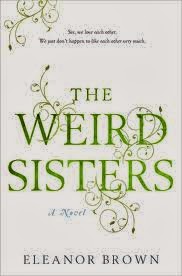
THE WEIRD SISTERS – Eleanor Brown

Weird. Can that be a sentence on its own? Well the book is weird, the characters are weird, and the title reference to Macbeth is weird because it lead me to think the sisters were going to be witches! They were not witches, they were just “weird.” It is a beauty though, nice iridescent white cover with beautiful and delicate green vines meandering over the cover and through the title. There is also a quotation on the front saying, “See, we love each other. We just don't happen to like each other very much,” which is apropos considering as the reader I didn't particularly like any of them either. The first person plural narrative also gave me pause. At first I kept thinking there must be a fourth person watching the other three referring to “we” all the time, but then there was only the three, therefore a collective first person. Recently I have come across some other contemporary writers using that voice such as Buddha in the Attic by Otsuka but it isn't my favorite.

My friend Wendy says I am weird because since high school, I have loved Shakespeare. I tell her good teachers made it real to me and taught me to appreciate Shakespearean references in contemporary media whether it is in literature, television, or simply in everyday references. This book is full of such references and quotations as well although to ad nauseam sometimes. Three eccentric adult sisters return home with the idea of ministering to their mother who is suffering from breast cancer. Each is really escaping from her failures and fears and is shocked to find her siblings also home. They find themselves revisiting their relationships with each other, dealing with their emotionally distant, renowned Shakespeare scholar/college professor father who insists on answering questions with rhymes, couplets, and quotations from plays, and figure out where they want to go with their futures. All that while dealing with a seriously ill mother and the eccentricities of their small college town in rural Ohio.

The sisters names are all from Shakespeare too and I am sure the author chose them to compliment each personality. The oldest is Rosalind named from “As You Like It” and is so controlling she cannot let the others make decisions but also cannot move on with her fiance to craft a new life on her own. Bianca from “The Taming of the Shrew” is bossy, bitchy, over-sexed, deep in debt, and at a loss for how to start over. Cordelia from “King Lear” has returned home after years of drifting as a drugged hippie, pregnant, and facing 30 with no skills or education.

The plots fit together nicely actually. As the family progresses down the path of surgery, chemotherapy, and rehab with the mother, the women also grow, change, evolve, and move on. For me it was fun to fit in the idea of a whole family who has lived for many decades with no TV, with a penchant for books, and a love of a centuries-dead writer as their compass. I liked it, but what I didn't like was the one plot line of spinster-librarian bowing out and prodding the library board to hire a non-librarian (Bianca) to fill her shoes, indicating that being a librarian isn't rocket-science. What! Librarianship isn't hard, you don't need a degree? Librarians beware when reading this book. But “All's Well that Ends Well” (wink wink).


Monday, March 10, 2014

ALONG THE WAY: THE JOURNEY OF A FATHER AND SON – Martin Sheen & Emelio Estevez with Hope Edelman

I do hate it when I write a review and forget to post it! This one is from August 2013 who knows why it slipped past my attention. Oh well... My church study group decided we wanted to watch the movie The Way with Martin Sheen and Emelio Estevez and also to read their book. We rented the DVD from the library, purchased our books, and met at a group members house this time instead of church. We made popcorn and cookies and had quite a nice party of it. After the movie we discussed both it and the book Along the Way. Great idea. I would recommend both to any discussion group.

The Way is a full length movie. A pilgrim story in which a busy professional father, Tom, must go to Europe to claim the remains and possessions of his son Daniel. Daniel died tragically while hiking the Camino de Santiago (The Way of St. James), a centuries-old pilgrimage over Spanish mountain country to the Cathedral de Santiago. After getting to Spain and collecting his son's things and his ashes Tom decides to make his own pilgrimage and scatter the ashes along the way that Daniel planned to hike. He even uses Daniel's backpack and hiking gear. On his trek Tom rethinks his relationship with his son and also even though he wants to be alone and to be left alone he ends up traveling with three other pilgrims. While hiking together they each work through some serious issues. It may sound dull but it is a really good story and the characters are unique and worth getting to know.

The book Along the Way is a memoir examining the relationship of this father and son. It is a delightful read, is not a “tell-all” of family skeletons, and most definitely not where you would go to get the dirt on Charlie Sheen's recent meltdowns. In dual first person voice Martin and Emelio have written alternating chapters which fit together quite nicely in this respectful book of a mature father and adult son reflecting on their relationship. The construction of the book is a back and forth type of dialog between the chapters. I understand that Hope Edelman conducted interviews with the two, constructed the manuscript, then submitted it to them for review and editing. The tone is respectful even when the chapters contain scenes of family trials, episodes of Martin's drunkenness, and Emilio's misbehavior.

Along the Way begins with Ramon Estevez (Martin's given name) childhood being raised in Dayton, Ohio one of ten children of immigrants. His mother was Irish and his father Spanish. He was raised with lots of love but little support for his desire to be an actor. He was young, just 21, when he married and started his own family. Times were very hard for an aspiring actor with so many responsibilities. With candor, telling stories that had to be painful, Sheen makes it clear how he struggled with being a father, husband, actor and alcoholic. Raised Catholic he also talks often of faith.

While not as philosophical as Sheen, Estevez also reveals his own foibles, struggles, and vices during his journey from “Brat Pack” actor, too young father, and budding screen writer to mature father, son, and responsible adult. The love of family, respect for each other, and dedication to becoming the best persons they can be is elucidated in this lovely book. The vehicle that makes the chapters flow into each other is the backstory of their working together on their move The Way, and their trek to the homeland to meet the relatives in Spain where Sheen's father had been raised. The same area in Spain is where Estevez has chosen to settle and have a vineyard. I would read this book again and I would watch the film again. They make me think and they make me feel hopeful. 

Friday, February 28, 2014

THE NAZI OFFICER'S WIFE – Edith Hahn Beer


Sometimes one needs to read a book that hurts. It helps you to remember to be vigilant so you can be a voice of protest in the present when you witness prejudice, meanness, and injustice. This is such a book. This autobiography by Edith Hahn Beer is very good even if it does make your hair stand on end and your heart ache.

What makes this Holocaust survivor book different is that this educated and outspoken Viennese Jewish woman was forced to hide from Nazi attention, becoming what is referred to as a “U-boat” or a person hiding in plain sight. After being forced into a ghetto and then to a work camp she returned to Vienna to find her family and friends deported or in concentration camps. At first she went underground but finding it too hard to survive she was able to use forged papers from a friend to start a new life in Munich. She married a Nazi Party member, Werner Vetter, held down a job, and bore a child but lived every day with the paralyzing fear of being found out. Edith lost herself during that time. Werner married a complete person that in reality didn't even exist. It came as no surprise that after the war he was not happy with the real person, lawyer, judge who was no longer home cooking and cleaning and being the hausfrau he wanted.

Hahn Beer began her story in the midst of the war, at her job for the Red Cross in a hospital for foreign war criminals where she witnessed a nurse smuggling food to patients and homeless Jews. This is to set the reader up for understanding that there were acts by ordinary citizens trying to deliver mercy during merciless times. She had assumed an alias, was pretending to be an uneducated farm girl and 21 when she was in actuality 29 and highly educated. The next chapter takes the reader back to her happy adolescence and progresses through to when the Nazis have taken over her world and she is denied the opportunity to take her last final to complete her law degree, through her years as a “U-boat” and finally to the present. The construction of the book works well to tell her story. Hahn Beer is never over sentimental, not exceedingly graphic, nor maudlin but her story is clear and heartbreaking. She makes it quite plain that the reader should face facts, the German people did know what was going on, the Christian church did nothing to help and indeed sanctioned the movement, and yet there were and are good people who did and will always step up.

Thank goodness Edith's long time friend and lover Pepi preserved their correspondence and her identity papers enabling her to reclaim her personage after the war and also helping her to reconstruct her experiences decades later. Unfortunately post war Austria under the Soviet occupation was not good. After her marriage to Vetter fell apart Hahn Beer fled to Britain and later to Israel. She died in 2009.


This book is a gem. It is the only one I have read about “U-boat” people. Once I picked it up I couldn't put it down. Knowing it was true at times nearly made my heart stop. In the thirties when Edith and her friends were in college their perspective of Hilter and his ilk were that he/they were idiots and ranters, not real thinkers, and not to be taken seriously soon to be gone. One friend commented that, “There might be a time when people would no longer know the difference.” That conversation brought goosebumps to my arms. Not only for them because that is what happened, but for us as I am afraid that those times may have come today to America. There seem today to be many idiots ranting on the TV and on the radio who are not “wise thinkers” at all, and many today don't seem to know the difference - indeed.

Wednesday, February 26, 2014

THE CASUAL VACANCY – J. K. Rowling

Irony – got up in the night with a migraine. Battled it with pain meds and ice packs for several hours until finally it subsided enough to enable reading a book. The Casual Vacancy on the shelf caught my eye so off I went to snuggle up with my cat and a blanket thinking about Rowling's first adult book. I had no idea a main character drops dead in the first chapter of a brain aneurism! At 3 in the morning with a pounding head let me tell you that seemed creepy and perhaps a little omen-ish. But I finished the book and am well so... false alarm.

In the small English town of Pagford there is much unrest. Many prominent people have serious personal issues and some are not who they pretend to be. We, as the reader get to see them in all their dented and tarnished glory. Written in third person with many characters to keep track of, there is no one to clearly identify with. No character is all good or all bad, nor are any without serious flaws. This book is mostly character study interjected with social issues magnified by anger, prejudice, and angst. It definitely has an edge. No pretty idyllic English quaintness at all. But I was hooked on the first page. The writing is wonderful and I loved the way Rowling slowly waltzes the reader into a man's life showing us his lovely wife and family, lets us see his angst at disappointing them and then BAM, the “casual vacancy” occurs. A casual vacancy occurs when a council member cannot finish his term because of resignation or death.

When a pillar of the small community, Berry Fairbrother, drops dead he leaves a beautiful young family, civic projects unfinished, and an open seat on the town council. Multiple battles and social skirmishes ensue. The rich snobs of the community seek an opportunity to rid themselves of the poor neighborhood which includes a methadone center by having it annexed to the nearby larger community. The local physician, a Muslim, battles prejudice in the community but also in herself with her inability to accept her imperfect child. A public school teacher battles his mental illness. A nurse tries to protect her children from her abusive husband. A councilman struggles to get his son elected in Fairbrother's place. A young girl desperately tries to save her brother from her prostitute-drug-addicted mother. A man battles his obesity and his obsession with young women. And that is only a sampling of the conflicts. No easy fixes or satisfying closure to be found in this book either but you will be intrigued and you will be forced to witness different vantage points of several social issues. I like that in a book and I did like this book. However, there were things I did not like and some very much. There was too much, and I would say, overdone teen sex, drugs, and alcohol. I am not averse to reading those things when they further the plot and seem to ring true but here it seemed like Rowling might be trying to make a point that she can write about current issues with grit and reality, but it didn't feel so to me, it felt unnecessary and contrived.

The characters are well written, the multiple plots intertwine well, and the writing style is much to my liking. I look forward to reading more of Rowling's adult lit if she polishes her work a bit. Possibly she should use a better editor? Could it be when an author is so popular less attention is given to making a work more readable? Not sure, but I am seeing more and more work recently which I and others feel are good but should have been better. All that being said I am still recommending this book to some friends. The cover art of my edition is very pleasing, looking a bit retro in black and yellow. The fancy font introducing each of the seven sections is a nice touch and the sections each emphasizing a basic plot meshing together is fun. A good work I say.


Saturday, February 22, 2014

ONE THOUSAND WHITE WOMEN: THE JOURNALS OF MAY DODD – Jim Fergus

One of my book groups was scheduled to read this so I scrounged used book stores until I found a copy, a bit battered but in one piece. Truthfully I prefer hard copies but then I feel a burning desire to keep it, so I try to decide if a book is truly “shelfworthy.” If a book is worthy of keeping in my small house then I will go for the hard. Sure that this would be one to pass along I opted soft. I enjoyed it, it isn't a “classic” or of great quality, some of it seems a bit clichĂ©, and perhaps the portrayal of the Cheyenne isn't very accurate. That being said I still liked it.

If the notes are to be believed the premise of the book is based on a real event. Apparently in 1854 at a national peace conference a noted Indian chief requested 1000 white women be sent West as brides in exchange for horses. The reasoning was that procreating with white women would be the impetus for assimilating the Indian nation into the white man's society. Of course this did not go well and indeed the women were never sent. Enter Jim Fergus to write a “what if” story of just such an endeavor. It is moved forward in time about twenty years and written in the form of a journal of one such woman sent to be a “savage bride.”

As you can imagine it was quite difficult to find 1000 willing women to go, so the prisons and insane asylums were culled for volunteers. Forty women are assembled. May Dodd had been put in an insane asylum by her wealthy family for having a “perverse personality” disorder. Which means she has been living with a man to whom she is not married and had children out of wedlock. The ability to leave the asylum, she thinks, may be her ticket to a new life and a future opportunity to perhaps be able to find her children. While on the way West May has a short but torrid affair with John Bourke, an army captain. He tries to get May to scrap her plans but he also cannot marry her because he is already betrothed, and besides she is not an acceptable bride for an officer.

As the traveling and the journalling progresses the reader gets to know the core group of women quite well and a motley crew they are. Among them are a gay environmentalist, a black Amazon ex-slave, an evangelical Bible-thumper, a terrified mute, feisty Irish twins, a Swedish farm girl, and a racist Southern belle. May steps up as a pillar of strength, an understanding influence, and a wise leader among the women. When she becomes the wife of an important chief she adapts to native life and helps her fellow wives assimilate into the tribe. Of course knowing any history of the time and place the reader knows things cannot end well. There are problems of course with communication and the clash not only of cultures but of strong personalities. The Natives are at war with invading white people but also with each other. There is brutality and hardship as well as love and dawning understanding between unlike minds. When the powers that be in Washington decide to take over the very land where the tribes of the women have been located, the army, including Bourke shows up. Heartbreak.


The segue to the present in my opinion works well and closes the story nicely. Whether or not the description of Cheyenne life is accurate, I enjoyed the adventure, the strange characters, and even the love stories. If you can't appreciate history re-imagined it isn't for you, but if you like the fantastic “what ifs” of a good tale told then you may want to try this one. Overall our book group liked it and we had a good discussion. I have already passed it along to a good friend. Hope she likes it.

AVIATOR'S WIFE – Melanie Benjamin

First of all I want to complain about the cover of the edition I had. It is always aggravating when a publisher doesn't take pains to make sure the cover art rings true. The woman on the cover seems not in the least bit to portray Anne Morrow Lindbergh. While being essentially about Anne we do look at Charles Lindbergh and from reading about Benjamin's research and other articles about him I am suspecting that this is a pretty accurate look at this American icon and his family. He does not come across as very likeable. Of course this is historic fiction so possible he wasn't as manipulative as it seemed here.

Anne Morrow was a smart, motivated, kind, and trusting woman. She was the product of a wealthy family having all the perks of good education, prestige, and opportunity. However, she was very much a product of her time (1920s America) and as did most young society girls she seemed to drift along into what was expected for young girls. She allowed herself to be “chosen” to be a wife by an American hero. Little thought was given to love or whether or not they would be good companions or even had anything in common. Charles was looking for a partner of good breeding and social standing, and one for whom he could rely on for intelligence and a sense of adventure.
It is easy to like Anne in this book and to at some level to admire her stamina, her willingness to support her spouse, and her quest for excitement. But sometimes her need to please and her desire to never disappoint grated on my nerves. Anne allowed Charles to be a bully and a tyrant in the home for which she could never seem to feel good about nor to stand up against. She always wanted to be stronger and a better mother but always capitulated to Charles wishes. It wasn't that he had no feelings, but his childhood had been so dysfunctional that I believe his perspective on good parenting was very warped. The kidnapping and murder of their first child was very hard to read about and very hard not to not hate Charles with his insistence on stoicism and keeping the grief at bay.

In either high school or college after reading about Lindbergh's heroics, it was at some point mentioned that he had been a Nazi sympathizer. Reading about how that transpired in this book made more sense to me. I was glad to discover Anne's inner strength when she came into her own through her writing. Now I want to scour this house to find my old copy of A Gift from the Sea (which I know is here somewhere) so I can read it again since I know a bit more about the author. 
It is sometimes hard for a person of the 21st century to understand the hows and whys of lives lived in a time and culture which we don't understand and so I like it when things evolve in a book in a way to make me feel and think as the main protagonist.

I was as shocked as she was to find out his darkest secrets and to be amazed at how he could publicly be so judgmental towards other men and people who he considered to have loose morals then..... well, we don't want to spoil the ending now do we?


Anne Morrow Lindbergh does not come across as good or bad, as a saint or a terrible sinner, just as an interesting person, a product of her times, but a human of basically good character with flaws. Overall a great beach read or for a rainy afternoon and it doesn't take long to read.