Search This Blog

Friday, October 10, 2014

THE STORYTELLER – JODI PICOULT

Oh my, I haven't read a Picoult book for a while! I had forgotten how she can twist a plot and turn a phrase to simply make your hair stand on end and take your breath away. Once I cracked this one open I did not want to put it down and when made to, I couldn't wait to pick it up again. In a way this book reminded me of Yan Martel's Beatrice and Virgil (a highly recommended book) which is also a story cloaked within another story with shades of WW II Holocaust thrown in designed to make the reader be horrified and mesmerized at the same time.

Sage Singer has followed a family tradition of being an excellent baker. At only 25, she lives fairly reclusive following an accident that disfigured her face and killed her mother. Her weekly visits to her grief support group help and it is there she befriends an older gentleman who also frequents the bakery where she works. Josef Weber always orders the same thing which he shares with his beloved dachshund and when he and Sage begin to converse she learns of his feelings of loss since the death of his wife. He has lived in their town for over 50 years, is a beloved retired high school teacher and a much-respected neighborhood volunteer. Sage enjoys Josef's company and his stories until the day he asks her to help him die.

Sage makes it clear that she will not ever participate in any such thing, pointing out moral and legal issues. She tries to distance herself from him. Not one to give up, Josef persists. He continues seeking her out and talking to her, and then he indicates that when she knows who he really is she will desire to help him. Most readers who have retained any history will know where he is trying to go with his stories. As his stories progress the darkness builds, the fear permeates every new chapter, and Sage's heart begins to ache not just for herself anymore.


Throw into this scenario the fact that Sage has a close relationship with her grandmother, Minka who is a Holocaust survivor and a great storyteller (who may or may not have known Josef), her boss is a former hippie-type nun, and her lover is a married funeral director! Enter the ever useful Department of Justice NAZI-hunter agent for a love interest and what else could a reader want I ask you? 

The stories are all so intricately woven, creating a beautiful webbed network for the reader to unwind. Questions arise as one reads this book, some of which may have no true answers. What is real evil? What is it that creates an evil person? What would one do to protect family? What entails forgiveness? Who can or should be forgiven? Who has the right to forgive, and who does not? Are there truly totally evil people? Can evil people be redeemed?

Saturday, October 4, 2014

THE BLUE BOTTE CLUB – PENELOPE J. STOKES

I read madly to finish my book club book for Monday because I have another one due next Tuesday and I need more time. Yikes! How do I let that happen? 

My friends know I have always had difficulty with fiction books specifically written for “inspiration” and this was of that genre so you can guess my reluctance. My reasons for staying shy of the genre are the usual, contrived plot, controlled vocabulary, too predictable etc. That is not to say I never recommend them or say they are bad, just not my cup-of-tea.

That being said, this was better than most of the genre that I have tasted. On Christmas Eve in 1929 four young girls place written dreams and plans for their future into a blue bottle. They make a pact to forever be best friends and place the bottle on a rafter in the attic of one of their homes. Sixty five years later that bottle is found upon the demolition of that house. Brendan Delaney, a local newscaster, takes the bottle on a quest to find the four girls, now octogenarians, to see if their lives turned out as they wished and hoped. The plot was very intricate and sometimes I got lost thinking about how Brendan got places so fast and easily? She had to go from one side of the country to the complete opposite, then north, and home again in a matter of days!

Of course, none of the girls got exactly what they wanted, and all of them had to live through many tribulations. They became adults during the Great Depression and during a time when women did not do the things these girls wanted to do such as go off to be a social worker, move to NYC to become an artist, take off for Hollywood and become an actor. Only one wanted to stay home, marry her school sweet-heart, and have a lot of babies, which she didn't get to do.

Truthfully, I much enjoyed each of the women's stories. It is my opinion however, that the best story is that of Adora Archer, the preacher's daughter who ran away to Hollywood. She ended up trying to climb the acting ladder too quickly by getting involved with a director, ending up pregnant, homeless, and jobless. When she turned to her family for forgiveness they proclaimed her dead and had a funeral. That is the only part of her story that didn't feel true to me. The author did spend a lot of time showing the reader the hypocrisy of the Archer's church as one pandering to the wealthy and turning away the needy, but turning away your own daughter, to me felt off. 

My second favorite was the girl who fled to the nunnery to escape her burgeoning family who ends up staying. She actually is the closest one to meet her dreams as she does become an artist and famous, just not via the avenue she sought.

Even though I liked all of the four life-stories, I did feel like the second half of the book got too preachy. Inside my head I felt like, “OK, I get it already!” But I also think people who love Christian fiction expect that and may look forward to it in their stories.

Sometimes I did the silent eye-roll when things got tied up too neatly, but I loved the four lives being so different and the convolution of each girl's path. I got the warm fuzzy “good-people-doing-good-because-of-their-religion” feeling via twisted life tales years ago when reading Billie Letts' books such as The Honk and Holler Opening Soon and Where the Heart Is, which I prefer – if that makes any sense to you, but if you are a female CF reader I would not pass this one by. It is not a guy book at all though and Letts' books can be enjoyed by all.

Monday, September 29, 2014

LIFE AFTER LIFE – KATE ATKINSON

Oops, didn't get my book finished for book club! Well dang it, when a month has 5 Mondays it's hard to keep appointments straight! Never-the-less I did finally get it finished, then it took me a few days to decide if I liked it. It wasn't one of the best I have read, but it was interesting. At some place in the middle it got put aside for a day or two so I could ponder.

When I tell friends I just read a “born again” novel their eyebrows raise because they all know that being a hard-core mainstream protestant I don't go in for any of that charismatic fallderoll. (I don't mind those who do, to each his own, and every person needs to find his or her own path.) But, this isn't that kind of “born again.” Ursula, the protagonist is literally reborn many times, thence living many parts of her life over.

The first chapter is but a page and a half. Ursula is 30 (in 1930) and assassinates Hitler only to be instantly killed herself. The next chapter is her stillbirth during a snowstorm in 1910 taking less than a page and a half. Next chapter – birth again, but this time the doctor arrives in time to resuscitate her. The chapters then begin to get longer and the method of death comes later, and often quite shockingly. It was necessary to put a sticky note on the contents page so in order to go back and check each time a new chapter started to get my bearings. I have never done that before! Markers on footnote pages and on map pages yes, but never on the contents page. Many chapters/lives take place leading up to and during World War Two. Even though every time she starts a segment of her life over she doesn't remember the other life, each reliving leaves some residual impressions and dark fears. She even tells a psychotherapist that she feels that her life seems like a palimpsest which it actually is!

Some of my friends who read it didn't like the jumping from time periods and the lost feeling of not knowing where you were each new chapter. That was disconcerting at times, but I liked it constructed that way. If you want to read this book and don't like that style I guess you could read all the chapters by date, as I have heard some have done with Frazier's book Cold Mountain. Probably the author wants us to feel as disjointed as Ursula does sometimes. The characterization is really good, her family is quirky, but also full of poignant and often sad people. My only big beef is that in several re-livings there is a murderer of young girls. Sometimes the murders are evaded and sometimes don't. He is seen by the reader but never unmasked in the book, and he appears to never see justice. I hate it when that happens, even though I know in real life many, if not most, murders go unsolved.


Since this review ended sooner than I thought please allow me to digress about my discount used book from abebooks.com. I read most of my books from the library, but if it is for a reading group I often like to buy old and used copies so I can write in the margins or pass them along to friends and family. Now, I love abebooks.com but once in a while the description does not accurately describe my purchase as it did not this time. A few times I have complained to them but I gave that up as too much of a nuisance. I wanted a beautiful hard copy to put in my personal library, but the one I received is a discarded copy from a library which apparently does not use bookends. (Some of you will know what I mean.) My copy has lain too long at an angle on the shelf, the spine is broken in three places, and the beautiful decorative front end page has been torn out. I truly hate it when the sales description says, “good” when the piece is actually simply “acceptable.” One for my garage sale next summer. 

Sunday, September 7, 2014

LIMBO

Limbo is a funny word. When I was a child in Van Wert, Ohio some of my elementary friends talked about a thing called "limbo" and they meant a place an unrepentant or unbaptized person went upon death which was not Hell but not Heaven. Sometimes I could give them money to put in a little can for their church and they would pray these people out of limbo, or so they said, if I am remembering it correctly. It was always a little scary to me and I never really bought it, so as the word "limbo" evolved over the decades to be used as in Webter's online third and fourth definition (an intermediate or transitional place or state; a state of uncertainty) I am now more comfortable using it. Well, that is where I have felt I have been since April 22, 2014 when my mother passed away. I never ever, even when we were told in October that she would never get better, imagined my life without my mother. She was an only child, I was her only daughter, I had only sons and only grandsons. It was just she and I for so many years and for the last six she lived with me. Limbo for me has followed. Isn't it a strange coincidence my first blog is about a girl in limbo?

RIP Marjorie Ellen Griesinger Chapman 1926-2014


IF I STAY – Gayle Forman

I work part-time in a public library in a very small town and last week a young girl came in to sign up for a library card. All went well until she was asked if she was looking for anything in particular. “Yes, If I Stay,” she said. “So sorry was the reply, we don't have that one,” and we knew because that was not the first inquiry and since the movie is newly in the cinema it is in demand. I hate hate hate it when that happens, I feel we should be able to get books fast and as soon as there is any indication it will be in demand. But such is not the case in small towns in Indiana with tiny budgets. Nevertheless, I then rushed out to buy it, read it, and donate it to the library so I don't have to witness any other eager teen's dismay.

If there is anyone who hasn't contemplated the state of “limbo” (that transitional state of not being in one place and yet not fully in the other) I have never met them. As a matter of fact that seemed to be a frequent topic among my school friends when I was about 11 or 12. No one seems to know if there really is such a state or what it would feel like to be thus. If I Stay is a tale of a girl not only in limbo following a car accident, but realizing she is to make the decision to pass on into death where all of her immediate family have gone, or to stay on the earth and live on which means bearing unquestionable grief, pain, and uncertainty.

Sounds like a painful read doesn't it? But it isn't! It is most certainly a teen book but as an adult I fully enjoyed it. It is fascinating to follow Mia from the scene of the accident to the hospital waiting room where she watches her extended family grapple with their own grief, worry, and acceptance. She must weigh the consequences of either of her choices as they do also. Some beg her to stay, but some give her permission to go if she wants to, and both of those feel like gifts to her and measures of lovingly granting her freedom.

I liked the structure of the book with alternate chapters being in the present then in the past. Characterizations were deftly written making the reader feel vested in many characters. Mia's parents are not portrayed as perfect and certainly not as traditional, which is refreshing. Friends, like Henry, and Kim have problems and foibles of their own that they are working through.


The love story between Mia and Adam is also non-traditional but feels real. This small book is an afternoon read and I am pretty sure should be a satisfying little movie. In the end of my copy there is a section of book club discussion questions, but better than that a little bit about where Mia is four years later. It will make you want to pick up the sequel.

Saturday, April 19, 2014

HOTEL ON THE CORNER OF BITTER AND SWEET – Jamie Ford

“What his son, Marty, never fully understood was that deep down there was an Ethel-shaped hole in Henry's life, and without her, all he felt was the draft of loneliness, cold and sharp, the years slipping away like blood from a wound that never heals.” (sigh) That quotation on page four portended a book to feed my soul. It is about his son not understanding how Henry feels at the loss of his much beloved wife, Ethel.

Occasionally such a book finds its way into your life. One with sentence structure and characterization to take your breath away. This is one for me. After reading it for the second time, it still holds that same “food for my heart and soul” as it did at our first encounter.

I also get to give away 20 brand new copies of this title on April 23, 2014 as a "giver" for World Book Night and my prayer is that those copies will find souls to nourish as it did mine. The book binding is artistically satisfying. A mix of butterscotch, vanilla, and green colors combined with a depiction of children by the sea in the mist (Henry Lee and Keiko Okabe) are enough to elicit feelings of anticipation for a great read.

Hotel is so well written as to make the reader actually feel what it must have been like to witness the nightmare of the rounding up for internment of Japanese-Americans during WW II. Families were torn apart, losing all their belongings, their homes, jobs, being persecuted by their own country that they were loyal to and mostly in which they were born. The people watching the nightmare transpire were equally emotional, some feeling confusion, helplessness, and broken-heartedness, but others with glee, hatred, and feelings of superiority.

But this book is not really about the internment. It is a multiple love story and one of finding oneself after major life altering events. In Seattle, Washington second generation Chinese-American Henry Lee lives in Chinatown while his best friend Keiko lives in Japantown. The Chinese and Japanese of Seattle are at odds already because back in China a war still rages between the countries, animosity seeping into the American subcultures. WW II is raging and public sentiment toward people of Japanese origin is quickly getting bitter and violent. Henry and Keiko both have earned scholarships to go to a white school where they work together in the cafeteria. She is a third generation American-Japanese girl. Her grandfather immigrated long ago and both her parents and Keiko were born in Washington and speak no Japanese. Henry and Keiko become best friends, spending many hours and days together haunting Jazz clubs listening outside to the music, spending time with Henry's jazz-playing friend, Sheldon, and haunting record stores looking for a rare record.

When the US military trucks show up with weapon-bearing soldiers to round up all the Japanese-Americans and herd them onto trains a chilling scene follows as Henry tries frantically to find his friend, and to understand why this is happening. Of course looters take over the Japanese neighborhoods immediately and it all happens so fast. It made me feel physically sick reading about it. We can only hope that we will not soon be repeating that in America, but today I see much of the same resentments being openly shown to our Muslim-Americans and it seems eerily similar.

After 40+ years pass The Panama Hotel is sold to a young woman who plans to restore it to its full prewar glory. In the basement she finds a cache of stored mementos and valuables belonging to the families that were sent away in 1942. Those families had thought they would be returning soon, which they never did. Henry recognizes Keiko's parasol.

On page 7 - “The more Henry thought about the shabby old knickknacks, the forgotten treasures, the more he wondered if his own broken heart might be found in there, hidden among the unclaimed possessions of another time. Boarded up in the basement of a condemned hotel. Lost, but never forgotten.” Thus Henry, with the help of his son and his dying best friend, embarks on a mission.

I hope I didn't make this book sound maudlin. It isn't at all, and I learned so much about the times in places like Seattle where large numbers of Japanese and Chinese descendants lived together yet very much apart. There is a whole sub-story about Henry trying to find his place as an American while dealing with the old traditions and prejudices of his father, and much irony in history that we can only see in retrospect, such as Mr. Okabe, an American born lawyer, being first persecuted, interned, then sent with the Japanese division of the Army to Europe to fight the Germans. Another favorite line of mine is on page 265 when Henry's father dies and he realizes he has too many obligations and therefore cannot wait for Keiko, his love, to return. He will help his mother in his father's place, go to China to finish his education, marry a nice “Chinese” girl, cover up his sadness and, “...do what he always did, find the sweet among the bitter.”

I'm sure your public library had this book for you to read and if it doesn't ask them to buy it. I will be read and I am glad to have read it twice!


** Footnote: my mother passed away a few days after I finished this entry and I did not get to hand out my free copies. However, my two friends Beth and Wendy did it for me. They passed out 20 copies of The Hotel on the Corner of Bitter and Sweet in Dunkirk Indiana and I pray at least some of those books brightened some lives as it did mine.

Sunday, March 16, 2014

THE WEIRD SISTERS – Eleanor Brown

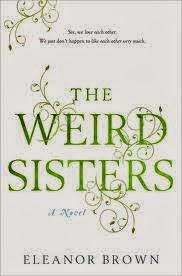
Weird. Can that be a sentence on its own? Well the book is weird, the characters are weird, and the title reference to Macbeth is weird because it lead me to think the sisters were going to be witches! They were not witches, they were just “weird.” It is a beauty though, nice iridescent white cover with beautiful and delicate green vines meandering over the cover and through the title. There is also a quotation on the front saying, “See, we love each other. We just don't happen to like each other very much,” which is apropos considering as the reader I didn't particularly like any of them either. The first person plural narrative also gave me pause. At first I kept thinking there must be a fourth person watching the other three referring to “we” all the time, but then there was only the three, therefore a collective first person. Recently I have come across some other contemporary writers using that voice such as Buddha in the Attic by Otsuka but it isn't my favorite.

My friend Wendy says I am weird because since high school, I have loved Shakespeare. I tell her good teachers made it real to me and taught me to appreciate Shakespearean references in contemporary media whether it is in literature, television, or simply in everyday references. This book is full of such references and quotations as well although to ad nauseam sometimes. Three eccentric adult sisters return home with the idea of ministering to their mother who is suffering from breast cancer. Each is really escaping from her failures and fears and is shocked to find her siblings also home. They find themselves revisiting their relationships with each other, dealing with their emotionally distant, renowned Shakespeare scholar/college professor father who insists on answering questions with rhymes, couplets, and quotations from plays, and figure out where they want to go with their futures. All that while dealing with a seriously ill mother and the eccentricities of their small college town in rural Ohio.

The sisters names are all from Shakespeare too and I am sure the author chose them to compliment each personality. The oldest is Rosalind named from “As You Like It” and is so controlling she cannot let the others make decisions but also cannot move on with her fiance to craft a new life on her own. Bianca from “The Taming of the Shrew” is bossy, bitchy, over-sexed, deep in debt, and at a loss for how to start over. Cordelia from “King Lear” has returned home after years of drifting as a drugged hippie, pregnant, and facing 30 with no skills or education.

The plots fit together nicely actually. As the family progresses down the path of surgery, chemotherapy, and rehab with the mother, the women also grow, change, evolve, and move on. For me it was fun to fit in the idea of a whole family who has lived for many decades with no TV, with a penchant for books, and a love of a centuries-dead writer as their compass. I liked it, but what I didn't like was the one plot line of spinster-librarian bowing out and prodding the library board to hire a non-librarian (Bianca) to fill her shoes, indicating that being a librarian isn't rocket-science. What! Librarianship isn't hard, you don't need a degree? Librarians beware when reading this book. But “All's Well that Ends Well” (wink wink).